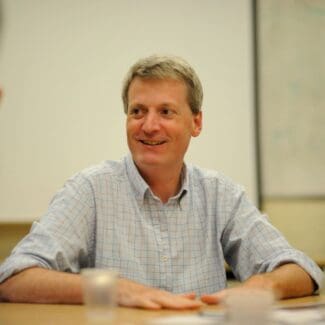
Matthew Freeman completed his PhD in Genetics at Imperial College London in 1987, followed by a five-year postdoctoral fellowship at the University of California, Berkeley. In 1992, he returned to the UK to establish his own research group in the Cell Biology Division of the LMB, where he later served as Head of Division from 2007 until his departure in 2012 to lead the Dunn School of Pathology at the University of Oxford.
During his time at the LMB, Matthew’s group initially focussed on developmental genetics in Drosophila melanogaster, uncovering key cell signalling mechanisms involved in cell fate and differentiation. The group’s long-standing interest in cell signalling pathways directed the group toward investigating the biology and genetics underlying membrane protein structure and function. This work included the discovery and characterisation of the rhomboid-like superfamily of proteases and pseudoproteases, revealing their diverse roles in intracellular signalling, cellular quality control, mitochondrial function, and inflammation.
Using Drosophila genetics, Matthew has also pursued the study of highly conserved proteins whose functions remain unknown in a collaboration with Sean Munro. Although driven primarily by fundamental discovery research, his work more broadly has important implications for understanding human disease, including immunity and cancer.
Alongside his research at the LMB, Matthew served on multiple scientific advisory boards and chaired the British Society of Developmental Biology. His contributions were recognised through several honours, including the 2001 EMBO Gold Medal, the 2003 Hooke Medal of the British Society for Cell Biology and election as a Fellow of the Royal Society in 2006.
Since leaving the LMB in 2012, Matthew has continued his research into transmembrane proteins and cell-signalling mechanisms at the Sir William Dunn School of Pathology, with a particular focus on their relevance to human disease. He has since been awarded the 2015 Novartis Medal and Prize, was elected as a Fellow of the Academy of Medical Sciences in 2015 and served as Chair of the Company of Biologists from 2015 to 2023 as well as Chair of the EMBO Council from 2022 to 2024.